Thursday, December 16, 2021

古代中國烏托邦思想 Ideas of Utopia in Ancient China


大同篇


大道之行也,天下為公,選賢與能,講信修睦。故人不獨親其親,不獨子其子,使老有所終,壯有所用,幼有所長,鰥、寡、孤、獨、廢疾者皆有所養,男有分,女有歸。貨惡其棄于地也,不必藏于己;力惡其不出于身也,不必為己。是故謀閉而不興,盜竊亂賊而不作,故外戶而不閉,是謂大同。

在大道成功執行的時候,天下是人人共有的,選拔品德高尚、能幹的人出來管理,講求誠信,力求和睦。所以人們不單照顧自己的父母,不單養育自己的子女。反而要使所有老年人能安享天年,壯年人能為社會效力,幼童能順利地成長,使鰥夫、寡夫、孤兒、獨居的、有殘疾的人都能得到最適當的供養。男子有稱心的職業,女子有如意的歸宿。人們都憎惡財物而將其扔在地上,不想自己私藏;人們為大家出力,而不單為己謀私利。因此陰謀詭詐之事永不發生,搶劫盜竊、叛亂和害人之事都絕跡,所以出去連大門也無須鎖上。這就是理想的社會的寫照。

《禮記·禮運第一節》


The Great Unity


When The True Way is successfully implemented, everything in the world is shared by everyone, virtuous and capable people are selected as stewards, and integrity and striving for harmony is emphasized. Thus, people not only take care of their own parents, and raise their own children, but also work to ensure that all the elderly members of society can enjoy their lives to the full, that healthy younger people can feel useful and fulfilled, that young children can thrive, and that widowers, widows, orphans, those living alone, and the disabled all receive the most appropriate support for their circumstances. Men enjoy satisfying careers, and women have happy homes. People hate material treasure and would throw it on the ground without a thought to appropriating it for themselves. People work for the good of the community, and not just for their own selfish benefit. Therefore, conspiracy and deceit never occur, and robbery, theft, rebellion, and murder are never heard of. You need not even lock the door of your home when you go out. This is a portrayal of the ideal society.

(Verse 1 of The Conveyance of Rites, a chapter in the Confucian Book of Rites)


今大道既隱,天下為家,各親其親,各子其子,貨力為己,大人世及以為禮。城郭溝池以為固,禮義以為紀;以正君臣,以篤父子,以睦兄弟,以和夫婦,以設制度,以立田里,以賢勇知,以功為己。故謀用是作,而兵由此起。禹、湯、文、武、成王、周公,由此其選也。此六君子者,未有不謹於禮者也。以著其義,以考其信,著有過,刑仁講讓,示民有常。如有不由此者,在勢者去,眾以為殃,是謂小康。

現在,大同社會已被破壞了,天下為一家一姓所私有,人們只親自己雙親,只愛自己的子女,將財貨藏於己身,而發揮心力的目的都為自己的利益。天子、貴族的頭銜,是以父傳於子的制度。外城都設有護城河來防禦。禮義作為大法的根基,用來規範君臣關係,用來使父親與子女的關係親密,用來使兄弟和睦相處,用來使夫婦能和諧,用來設立制度,用來確立田地和住宅,用來表揚有勇有智的人,用來把自己的功勞寫到賬本上讓別人知道。因此,鉤心鬥角就隨之而生,戰爭也因此而起。夏禹、商湯、周文王、武王、成王、周公,就是這種情況孕育出來的翹秀。這六位君子,沒有一個不是把禮當作最高的準則,用禮來彰顯正義,考察誠信,指示過錯,以仁愛為典型,講求禮讓,向百姓展示這一切都是常規。不按禮行事的官員要被革職,而民眾視之為禍害。這就是小康社會的模式。

《禮記·禮運第二節》

Now, the Great and True Way is veiled, and so the ideal society The Great Unity) has been destroyed, and the country has become the private possession of the royal family. People only care for their own parents, and only love their own children. They desire to accumulate wealth for themselves, and expend their energy and talents only for their own benefit. The titles held by the emperor and the nobles are passed on from the father to son, and the city has to be defended by a moat in order for peopler to feel secure. As the foundation of law and order, ritual and protocol are used to regulate the relationship between monarchs and subjects, to oblige fathers and children to draw close to each other, to compel brothers to live in peace, to create matrimonial harmony, to establish systems, to confirm the boundaries of fields and residences, to commend brave and wise persons and allow them to flaunt their merits before others. As a result, intrigue and conspiracies abound, and wars and armed conflicts have arisen. Yu of the Xia Dynasty, Tang of the Shang Dynasty, and Wen Wang, Wu Wang, Cheng Wang of the Zhou Dynasty, along with the Duke of Zhou, were outstanding individuals bred in this environment. Every one of these six kings regarded rites and protocol as the highest standard by which to measure behavior, and used etiquette to demonstrate justice, prove integrity, and identify faults. They took benevolence as a model, emphasized courtesy, and showed the people that this is how affairs ought to be conducted. Powerful officials who failed to act according to such standards were removed from office, and the people regarded them as injurious to society. This is how the world is today.


桃花源記

朝代:魏晉
作者:陶淵明

原文

晉太元中,武陵人捕魚爲業。緣溪行,忘路之遠近。忽逢桃花林,夾岸數百步,中無雜樹,芳草鮮美,落英繽紛,漁人甚異之。復前行,欲窮其林。

林盡水源,便得一山,山有小口,彷彿若有光。便舍船,從口入。初極狹,才通人。復行數十步,豁然開朗。土地平曠,屋舍儼然,有良田美池桑竹之屬。阡陌交通,雞犬相聞。其中往來種作,男女衣着,悉如外人。黃髮垂髫,並怡然自樂。見漁人,乃大驚,問所從來。具答之。便要還家,設酒殺雞作食。村中聞有此人,咸來問訊。自云先世避秦時亂,率妻子邑人來此絕境,不復出焉,遂與外人間隔。問今是何世,乃不知有漢,無論魏晉。此人一一爲具言所聞,皆嘆惋。餘人各復延至其家,皆出酒食。停數日,辭去。此中人語云:「不足爲外人道也。」 

既出,得其船,便扶向路,處處志之。及郡下,詣太守,說如此。太守即遣人隨其往,尋向所志,遂迷,不復得路。

南陽劉子驥,高尚士也,聞之,欣然規往。未果,尋病終,後遂無問津者。


白話文

東晉太元年間,武陵郡有個人以捕魚爲業。有一天,他沿著溪水行船,忘記了走了多遠。忽然他走進一片生長在溪水的兩岸的桃花林,長達幾百步沒有別的樹。足下新鮮的草新鮮美麗,落花紛紛地散在地上。漁人對此景色感到十分詫異,繼續往前划船,想走到林子的盡頭。

桃林只延伸到溪水發源的地方,而在那裏出現一座山。山裡有個小洞口,洞裏彷彿有透出一點亮光。於是漁人下了船,從洞口進去了。起初洞口很狹窄,僅能容一人通過。又走了幾十步,突然變得開闊明亮了,有一片平坦寬廣的土地,一排排整齊的房舍。還有肥沃的良田,美麗的池塘,桑樹竹林之類的東西。田間小徑交錯相通,雞鳴犬吠到處可聽到。人們在田野裏來往耕作,男女的穿著奇特。黃髮老人和有垂髫的孩童都是安然自在的樣子,自得其樂。

村裏的人看到漁人,大吃一驚,問他是從哪兒來的。漁人詳細地回答。村裏有人就邀請他到自己家裏,擺酒殺雞,請他吃飯。村裏的人聽說來了這麼一個人,就都前來打聽消息。他們說祖先爲了躲避秦時的戰亂,領着妻子兒女和同鄉來到這個與世隔絕的地方,不再出去,因而跟外面的人斷絕了來往。他們問漁人現在是甚麼朝代,他們連漢朝都不曉得, 更不用說魏朝和晉朝。漁人把自己知道的事一一告訴他們,聽完以後,他們都駭惜。其餘的人各自又把漁人請到自己家中,擺上酒飯款待他。漁人停留了幾天才向村裏人告辭,離開時村裏的人對他說:“不可對外面的人說 (有我們這樣一個地方)!”

漁人出來以後,找到了他的船,就沿著原路回去,處處都做下記號。到了郡城,謁見太守,說出了這番經歷。太守立即派人跟着他去,尋找之前所做下的記號,但迷失了方向,再也找不著通往桃花源的路。

南陽人劉子驥是個清高的隱士,聽到這件事就很高興地計劃前往。但沒有結果,還在尋找時因病逝世。此後就沒有人再問通往桃花源的路線。


桃花源記  The Peach Blossom Spring

晉太元中,武陵人,捕魚為業,緣溪行,忘路之遠近;
In the time of Jin Taizhong, a man from Wuling, a fisherman by trade, was traveling along the edge of a stream, and forgot how far he had come.


忽逢桃花林,夾岸數百步,中無雜樹,芳草鮮美,落英繽紛,漁人甚異之。
All of a sudden, he came upon a peach blossom wood. On both sides of the shore there were no other trees for a hundred paces, the fragrant grasses were fresh and beautiful, and the falling leaves and blossoms were a kaleidoscope of color. The fisherman was greatly surprised by this scene.


復前行,欲窮其林。
He continued onwards, wanting to find the end of this wood.


林盡水源,便得一山。
At the end of the wood was the source of the stream, and there appeared a mountain.


山有小口,彷彿若有光,便捨船,從口入。
There was a small opening in the mountain and it seemed as if light was filtering through, so he left his boat and went in.


初極狹,纔通人;
At first it was so narrow that only a single person could pass.


復行數十步,豁然開朗。
However, after several dozen paces more, it suddenly became wide and bright.


土地平曠,屋舍儼然。
The ground was flat and expansive, and upon houses were neatly arranged.


有良田、美池、桑、竹之屬,阡陌交通,雞犬相聞。
There were fertile fields, scenic pools, mulberry trees and bamboo, as well as criss-crossing roads and paths. The sounds of chickens and dogs could be heard.


其中往來種作,男女衣著,悉如外人;
In the fields people were working planting seeds, men and women were clothed in strange ways.


黃髮、垂髫,並怡然自樂。
Both the old and the young appeared joyful and happy.


見漁人,乃大驚,問所從來;
When they saw the fisherman they were shocked, and proceeded to inquire where he had come from;


具答之。
he told them them everything.


便要還家,設酒、殺雞、作食。
Then they invited home, brought out wine, killed chickens and made a meal.


村中聞有此人,咸來問訊。
Once it was heard in the village that such a person had come, everyone came to ask him questions.


自云:「先世避秦時亂,率妻子邑人來此絕境,不復出焉;
They explained: "Our ancestors fled the chaos in the time of the Qin Dynasty, and brought their wives, children and neighbors to this isolated place. After that, they never left;"


遂與外人間隔。」
"As a result, we have been separated from the people outside."


問今是何世;
They went on to ask about the present era.


乃不知有漢,無論魏、晉。
They had not even heard of the Han, let alone the Wei or the Jin Dynasties!


此人一一為具言所聞,皆歎惋。
The fishermen told all he knew, and everyone gasped in horror and astonishment.


餘人各復延至其家,皆出酒食。
The other people all wanted  him to visit their homes too, and all brought out wine and food.


停數日,辭去。
He stayed for several days, then said his goodbyes and made to leave.


此中人語云:「不足為外人道也。」
At that, the people there said: "Do not tell the people outside (about this place)."


既出,得其船,便扶向路,處處誌之。
At that, the fisherman went out, recovered his boat, and followed the route back, placing markers down at every point.


及郡下,詣太守,說如此,太守即遣人隨其往,尋向所此誌,遂迷不復得路。
Upon reaching the county seat, he went to see the governor, and recounted his experience. The governor immediately sent people with the fisherman to find the place, searching for the markers he had left, but they got lost and could not find the way.


南陽劉子驥,高尚士也,聞之,欣然規往,未果,尋病終。
Liu Ziji of Nanyang was a noble scholar who heard of this and excitedly embarked upon an expedition, but with no result; he died of illness during his search.


後遂無問津者。
After that, there were none who inquired about the route again.


《桃花源詩》
嬴氏亂天紀,賢者避其世。
黃綺之商山*,伊人亦雲逝。
往跡浸復湮,來逕遂蕪廢。
相命肆農耕,日入從所憩。
桑竹垂餘蔭,菽稷隨時藝。
春蠶收長絲,秋熟靡王稅。
荒路曖交通,雞犬互鳴吠。
俎豆*猶古法,衣裳無新製。
童孺縱行歌,斑白歡遊詣。
草榮識節和,木衰知風厲。
雖無紀曆誌,四時自成歲。
怡然有餘樂,于何勞智慧。
奇蹤隱五百,一朝敞神界。
諄薄既異源,旋復還幽蔽。
借問遊方士,焉測塵囂外。
願言躡輕風,高舉尋吾契。


白話文

秦始皇擾亂上天的紀綱,賢人都避世隱居去。
夏黃公和綺里季到了商山,桃花源居民的祖先也走得無影無踪。
他們去的踪跡湮沒了,通往世外桃源的小路也就荒廢了。
爲了活命他們努力耕作,太陽下了山才休息。
桑樹竹子已長得綠蔭滿地,豆子穀物都按季節種植。
春蠶養大能收成蠶絲,秋收無須繳納帝王的稅。
荒蕪的小路無人行走,只聽鷄犬互相鳴吠。
祭祀仍遵古禮法,衣裳也沒有新款式。
小孩縱情唱歌,上了年紀頭髮半白的人高興地彼此拜訪。 
花草茂盛便曉得時節和暢,樹木落葉就知寒風甚烈。
雖無記節令的曆法,但四季交替就自然成一年。
日子過得欣悅快樂,何必勞動智慧?
那奇特的路徑隱蔽了五百年,有一天桃花源神奇的境界忽然顯露出來。
這裡因淳樸和外界風氣大不相同,就迅速地回復幽隱深蔽。 
借問雲遊四方的僧人,如何測知世外桃源的所在?
我願踏上輕快的風,高飛尋找義氣相和的朋友。


*據說夏黃公為齊國人,因隱居夏里修道而得名。夏里因傳為大禹的石鈕村故里,故有“夏里”之稱。夏黃公是秦漢之際的一位著名隱士,與隱士綺里季,東園公,甪里並稱為“商山四皓”。三人在秦朝時不滿秦始皇焚書抗儒的暴行,從秦代到漢初同時隱居於陝西的商山。又因四人都是“年皆八十有餘,鬚眉皓白”故也稱“四皓隱士”。漢朝初年,夏黃公曾輔佐太子劉盈,令漢高祖劉邦非常驚訝。劉邦曾多次邀四人協助,但都被拒絕。後劉邦欲改立戚氏所生的趙王為太子,呂后很着急,張良就獻策請來四皓輔助太子,終於使太子的地位得以保住。但在太子劉盈即位漢惠帝后,朝政大落其母呂后手中,四人知道報國無望,就又重歸深山隱居。

*俎豆: 典出《論語·衞靈公》和《史記》卷四十七〈孔子世家〉。俎豆為古時祭祀、宴饗時盛食物用的禮器,也泛指各種禮器。後引申為祭祀和崇奉之意。


The Peach Blossom Spring Poem 
by Tao Yuan-Ming (Jin Dynasty)

When The King of Qin disturbed the heavenly law, the wise men retired into seclusion.
When *Xia Huanggong and Qi Liji arrived at Shang Mountain, the ancestors of the dwellers in the Peach Blossom Paradise also vanished from the world.
All traces of them were lost, and the path leading into paradise was overgrown with weeds.
They worked hard to survive, and only rested when the sun went down.
Mulberry trees and bamboo grew and shaded the ground, and beans and grains were planted according to the seasons.
In springtime silk was harvested from silkworms, and there was no need to pay the royal tax on the autumn harvest.
No one walked the deserted path, and only chickens and dogs could be heard calling at each other.
Sacrifices still followed the ancient rituals, and there were no new styles of clothing.
The children sang in abandoned merriment, and the aged with half-white hair joyously paid visits to one another.
The luxuriant growth of flowers and plants told them spring had arrived, and the falling leaves and cold wind spoke of the winter season.
Although there was no calendar to mark time, the passing of the four seasons naturally became yet another year.
They were happy and contented with their lives, so why labor after worldly wisdom?
After that peculiar path had been hidden for five hundred years, one day the magical realm beyond the Peach Blossom Spring suddenly manifested itself once more.
But the simple way of life was at such great odds with the atmosphere of the outside world, that it quickly vanished again.
I would inquire of the monks who travel the world, How can I learn of where that paradise abides?
I yearn to travel on the brisk wind and fly high to find those people who are so congenial to my own soul!


*It is said that Xia Huanggong was a native of the state of Qi, and he got his name because he lived in Xia Li and practiced their philosophical arts in seclusion. Xia Li is known as "Xia Li" because was thought to be the hometown of Dayu, the first King of the Xia Dynasty. Xia Huanggong was a famous hermit in the Qin and Han Dynasties. Together with Qiliji, Dongyuangong, and Luli, these three, dissatisfied with the burning of books by the First Emperor of Qin, retired to Shang Mountain. It is said that the four of them were all more than 80 years old, with white beards and eyebrows. In the early years of the Han Dynasty, Xia Huanggong assisted Crown Prince Liu Ying, which greatly surprised the Han Emperor Liu Bang. Liu Bang had repeatedly invited the four  assist him in the past, but had always been refused. But later, when Liu Bang desired to strip the title of Crown Prince from Liu Ying and confer it on Prince Zhao, Empress Lu (the mother of Liu Ying) was extremely anxious, so Zhang Liangadvised that the four hermits should be invited to assist Prince Liu Ying, and due to this the position Empress Lu's son was eventually preserved. Unfortunately, after Crown Prince Liu Ying ascended to the throne as Emperor, the government fell into the hands of his mother, and those four wise men realized there was no hope of serving their country effectively, so they returned to the mountains to live in seclusion.


詩名: 送 崔 九*
朝代: 唐代
作者: 裴 迪    詩體: 五 言 絕 句

歸山深淺去,須盡邱壑美。
莫學武陵人,暫游桃源裡 。

Tang Dynasty Poem by the poet Pei Di
Farewell to Cui Jiu*

However deep into the mountains you go,
You should enjoy the hills and valleys to the fullest.
On no account follow the man from Wu Ling,
in making only a brief sojourn in paradise.

*崔九:崔滌,在兄弟中排行第九,中書令崔湜的弟弟。玄宗        時,曾任殿中監,出入禁中,得玄宗寵幸。

*Cui Jiu (Cui the Ninth): His name was Cui Di, ranked ninth among his brothers, and the younger brother of  Cui Shi, Overseer of the Royal Secretariat. When Xuanzong was Emperor of the Tang Dynasty, Cui Jiu served as the Palace Superintendent, and won royal favor in this position, being able to come and go as he pleased.


Saturday, December 11, 2021

台南的贔屭 Bixi Turtles in Tainan

 台南的贔屭

Bixi Stone Turtles in Tainan


有一句諺語說「龍生九子,個個不同」,意指一家兄弟姊妹雖是同一對父母所生,但個性及喜好卻各有不同。
There is a Chinese saying that goes, "The Dragon gave birth to nine sons, all of whom were different." This means that although a family of brothers and sisters may be born to the same parents, they all have very different personalities, strengths, and preferences.

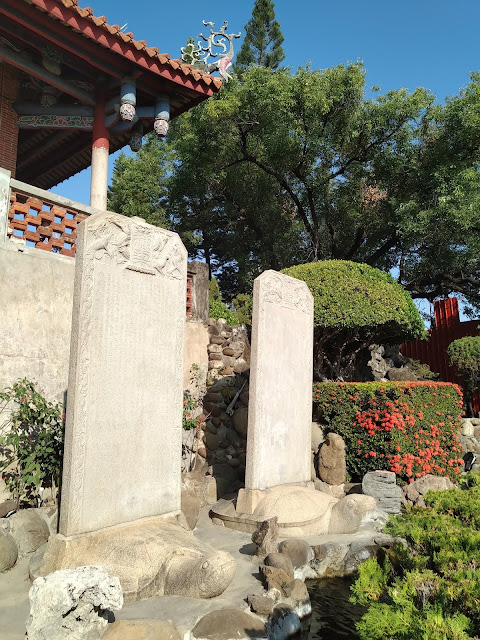
贔屭 (ㄅㄧˋ ㄒㄧˋ ) ( bì xì ),又稱龜趺 (ㄈㄨ)( fū )、霸下、及填下,為龍生的九子之一,而九子都不像龍。到底哪些怪獸該組成龍的九個兒子,眾說紛紜,有不少不同版本,但都說各有各地的喜好,因此會出現在廟宇建築不同位置。神話中的贔屭看起來像龜,有齒 (龜類並沒有),非常喜愛負重,力大到可馱負三山五嶽,所以人們在需要支撐重物的地方就請贔屭出場了。因此贔屭多為石碑、石柱底座及牆頭裝飾,是長壽和吉祥的象徵。傳說贔屭上古時代在江河湖海裡興風作浪,但後來大禹收服了它。贔屭服從了大禹的指揮,推山挖溝,疏通河道,對治水有貢獻。
The Bixi Turtle according to legend is one of the nine sons of the Dragon, but none of those sons looked very much like their parent. There are various views concerning which mythical creatures should be included among the nine sons, but there is a consensus that the sons were nine in number and that they were all unique in their characteristics and strengths. It is because of their various abilities that they appear in different locations on religious architecture. The mythological Bixi looks like a turtle or tortoise, except that it has teeth. The Bixi loves to carry heavy weights, and possesses a strength so great that it can move mountains. This supposed penchant for carrying heavy loads is why people call on the Bixi whenever there is a need to transport or support hefty objects. Thus, bixi usually appear beneath stone stelae and pillar bases, although they can also sometimes be seen as decorations on the top of walls. They are a symbol of longevity and good fortune. Legend has it that at the dawn of history, the Bixi caused huge waves on rivers, lakes and seas, but Yu the Great, eventual founder of the Xia Dynasty, subdued it. The Bixi obeyed Yu’s commands, moved mountains, dug ditches, dredged rivers, and thus made an essential contribution to the taming of the flood waters.


設立贔屭石碑的傳統可追溯到公元3世紀(漢末)之前。幾個世紀以來,中國文化中一直使用贔屭石雕作為紀念石碑和碑銘的裝飾底座, 特別是在後來的皇帝的陵墓中以及為紀念重要事件。贔屭也用於橋樑和拱門的底部。 為了帶來好運而撫摸贔屭長年累月可能導致石雕磨損。 贔屭遍布東亞的日本、韓國、越南、蒙古,甚至俄羅斯遠東地區。
The tradition of setting up bixi stelae can be traced back to before the Third Century AD (the end of Han Dynasty). For centuries, bixi carved from stone have been used in Chinese culture as decorative bases for memorial stelae and inscriptions, especially in the tombs of later emperors and to commemorate important events. Bixi are also used as decorative supports for bridges and arches. The tradition in some areas of rubbing bixi for good luck may over many years cause the stone to wear away, and has thus become an issue of concern to historical conservationists. Bixi are spread all over East Asia, and can be found in Japan, South Korea, Vietnam, Mongolia, and even the Russian Far East.

乾隆51年 (1786年) 時期發生林爽文和天地會之亂,福康安將軍平定叛亂後乾隆皇帝寫下了紀念碑文,十面石碑和十座花崗岩 (俗稱金門麻糬石) 雕刻的贔屭 (含「石全石美」之意) 在乾隆53年 (1788年) 運往台灣。石碑高3.1公尺,寬1.4公尺,其中四座全刻滿文,四座全刻漢文,二座則是漢滿文合刻的對照版。儘管碑文互異,下端的每個
龜身基座卻尺寸一樣。然而,頭部和頸部造型以及龜殼厚度並沒有完全相同。這十隻背負了石碑的巨龜,頭部是標準的龜形,而最正統的「贔屭」則應該是龍頭龜甲。這大概是因清朝去古日遠,對「贔屭」的形制並未完全遵古所致。然而在中國大陸各地,目前所遺留下來贔屭,有龍頭龜甲形狀的仍很常見。
In the 51st year of the Qianlong Emperor (1786), Lin Shuangwen led the Tiandihui Rebellion against the Qing government in Taiwan. After General Fukangan put down the rebellion, Emperor Qianlong wrote a commemorative text to be carved on ten stone stelae supported by ten carved bixi. The number ten was considered illustrative of what was for the Qing Dynasty a perfect outcome to the uprising. The stelae and bases, both carved from granite, were shipped to Taiwan in the 53rd year of Qianlong (1788). The stone stelae are 3.1 meters high and 1.4 meters wide. Four of them are engraved only in the Manchu language, four are engraved solely in Chinese, and two are in both Manchu and Chinese. Although the inscriptions differ, each bixi pedestal is of the same proportions and shape. However, the heads, necks, and shell-thicknesses of the turtles are not all identical. These ten giant bases possess a standard turtle-shaped head, whereas the most orthodox bixi should perhaps have a dragon head and turtle shell. This could be due partly to the fact that since the Qing Dynasty was distant in time from the origin of the Bixi legend, conformation to what purists would consider most appropriate was no longer an issue. Nevertheless, in many parts of Mainland China, it is still very common to find bixi which have turtle shells matched with dragon heads and feet.

不料,這十塊石碑和十隻石龜從福建運抵府城,在台江內海從大船搬上小船時,有一隻石龜底座突然掉入海中,尋之不著,與其面對朝廷的責難,主事官員們選擇冒險用臺灣砂岩,仿製了另一座贔屭,期望能順利瞞天過海。然而,仿製的贔屭石材雕工皆不及原作,若與其他九座贔屭同置一處,勢必相形見絀。於是九座贔屭碑保存於臺南,仿製品送往嘉義。
The ten granite stelae and turtles were transported from Fujian to Fucheng (Tainan), but when they were transferred from the large ship to a smaller vessel in the Taijiang Inland Sea, one of the stone turtle bases suddenly fell into the sea and could not be recovered. Rather than facing the censure of the imperial court, the officials in charge opted to take the risk of having another bixi pedestal made locally from sandstone. However, the imitation was not as good as the original in either workmanship or material, and if placed alongside the other nine, the difference would be too obvious to ignore. Consequently, the nine original granite bixi and their accompanying stelae were preserved in Tainan, while the imitation was sent elsewhere.

所以其中漢滿文合刻的石碑配那座砂石的替代底座,當年有分贈諸羅(嘉義),放於縣城東門附近的福康安生祠內。後來此石碑在1906年梅山大地震後移到今新榮路三商百貨附近,目前擺在嘉義公園裡面,名為福康安紀功碑,故「假贔屭、真石碑」的狀態有保存至今。其餘九隻本來立於今台南南門路附近的福康安生祠,1935年日方移往大南門甕城,1960年後移到赤崁樓安置。
It thus came about that a granite stone stela engraved in both the Chinese and Manchu scripts along with the replacement base of sandstone were donated to Zhuluo (modern Jiayi) and placed in the Fukangan Temple near the east gate of the county capital. Later, after the Meishan Earthquake in 1906, the bixi and stela were moved to the Sanshang Department Store near Xinrong Road. It is currently located in Jiayi Park, and is called the Fukangan Memorial Stela. Therefore, the "fake bixi and genuine stela" have been preserved together to this day. The remaining nine bixi were originally located at the Fukangan Temple near the present Nanmen Road in Tainan. In 1935, the Japanese moved them to the Great South Gate Barbican, and after 1960 they were relocated to Chikan Tower, where they remain until the present day.

乾隆皇帝認為臺灣「民情剽悍,雖經此一番懲創,恐事過即忘」,於是下令在臺灣建立福康安生祠,在生祠前方建四間碑亭安放贔屭碑,其位置在今日南門路郵局一帶。清代以後,這九座贔屭碑,曾三次遷移,其中二次在日治時期,一次在國民政府來臺後。
The Emperor Qianlong believed that the people of Taiwan possessed “fierce sentiments”, and he wrote that “even though they have been punished, they will forget the incident.” Partly for this reason he ordered the establishment of the Fukangan Temple in Tainan, along with the construction of four pavilions to house the stelae and their bixi. This would have been in what is today the area near the post office in Nanmen Road. After the Qing Dynasty collapsed, these nine stelae were relocated three times, two times during the Japanese occupation, and one after the Nationalist government came to Taiwan in 1949.


贔屭碑的第一次遷移是明治44年(1911),當時總督府在臺南廳 (即國立臺灣文學館現址)附近設農園,將贔屭碑所在地包含其中,贔屭碑此次並未離開原址,但在排列上進行了小移動,將清代陳列的方式調整為一字型的。
The first relocation of the bixi and stelae was in 1911. At that time, the Japanese governor set up a farm near Tainan Hall (the current location of the National Museum of Taiwan Literature) which encompassed the region where the stelae were located. They did not leave their original site, but a minor adjustment was made in that their positional arrangement was changed so that they formed a single row.


贔屭碑進行第二次遷移是在昭和5年(1930)。此次遷移起因是總督府為整治大南門一帶,計畫在附近設小公園。因為又時逢「臺灣文化三百年紀念會」,市府將贔屭碑搬遷到大南門甕城內,與公園合併為一個新景點。
The second relocation of the Qianlong Bixi took place in 1930. The reason for this relocation was that the Japanese governor planned to create a small park as part of the renovations of the Great South Gate area. Since this coincided with the "300th Anniversary Celebration of Taiwan Culture," the city government moved the bixi and stelae within the Great South Gate Barbican, merging it with the park to create a new attraction.


臺南市長辛文炳於民國50年(1961)在籌備鄭成功復臺三百週年的慶典活動時,認為因贔屭碑頗具歷史價值,該將九座贔屭與石碑由南門城移到赤崁樓讓民眾觀賞。這就是贔屭碑第三次遷移的原因。
In 1961, the Mayor of Tainan City was preparing the celebrations for the 300th anniversary of the arrival of Zheng Chenggong in Taiwan. He believed that, due to their historical value, the nine turtles and their stelae should be moved from the Great South Gate to Chikan Tower for more people to enjoy. This is the reason why the bixi were moved a third time.


至於那座掉入港中的贔屭呢?據說每當退潮時會浮出水面,吸取日月精華,並獲「白蓮聖母」附身。在西元1911年那隻被漁民下網捕魚時打撈上岸迎回保安宮,置於廟庭院供奉。原該放石碑的凹槽經常被雨水灌滿,傳說此水對醫治惡疾頗有靈效,於是這座贔屭被民眾稱為白蓮聖母。今日這座贔屭在南廠保安宮可以看到。
And what about the turtle base that fell into harbor on its arrival in Taiwan? It is said that it would periodically appear above the surface at low tide and absorb the essence of the sun and moon, eventually becoming possessed by the spirit of the ‘Mother of the White Lotus’. In 1911, this bixi stone base was salvaged by fishermen and welcomed into the Baoan Temple, where it was placed in the courtyard. Since it was exposed to the elements, the stela groove on the back of the turtle filled with water whenever it rained. According to believers, this water is effective for the curing of diseases. Thus, this tenth original Qianlong granite bixi became known as the ‘Mother of the White Lotus’ by the people. Today this turtle can be seen comfortably ensconced in an alcove in Tainan Baoan Temple.


因此,台灣有幾座古時製的贔屭呢? 答案顯然是十一座。十隻是乾隆皇帝命人雕刻後自福建運往台灣的,而最後一座是清代台灣官員為了躲避責罰製作的砂石仿製品。
So, in conclusion, how many ancient bixi stone bases are there in Taiwan today? The answer is evidently eleven. Ten were shipped to Taiwan after being carved in Fujian on the orders of the Qianlong Emperor, and the eleventh is an imitation made from Taiwan sandstone which was commissioned by local officials in order to avoid possible punishment for losing one in the sea on its arrival in Taiwan.


赤崁樓的九隻贔屭由堅硬花崗石製,故至今狀況仍然良好。
The nine bixi and their stelae at Chikan Tower are made of hard granite, and so are still in good condition despite their age.


贔屭與石碑現代仿製品 (赤崁樓) 
A modern imitation of bixi and stela (Chikan Tower)

乾隆贔屭細節說明
Details of the Qianlong Bixi 


碑額: 爲一團龍,口啣刻有篆體 「御製」字額牌。「御製」 與「龍」都是皇帝專屬的圖樣, 顯示此碑的來歷不凡。
The top of the stela shows a coiled dragon with the words "Commissioned by the Emperor" in seal script in its mouth. This design shows the royal origin of the monument, as the Emperor had exclusive rights over the use of this design.


雕飾:兩邊還攀附著8條行龍。團龍怒目瞪視,造形十分威嚴,而行龍大小、姿態各異,同樣具有動感。龍足有5爪,與一般廟3或4爪造形的龍不同。5爪的爲「真龍」,是皇帝專屬的圖樣; 3或4爪的稱爲「蟒」,民間才可以使用。真龍造形的雕刻較爲罕見。
There are a total of 8 dragon carvings at the sides. The center dragon glares majestically, while the other dragons, equally dynamic, are of different sizes and in various postures. The feet have 5 claws, which is different from the general temple dragons which only have 3 or 4 claws. The 5 claws signify the "True Dragon", which deisgn could only be used by the emperor. Those with 3 or 4 claws are called "pythons", and could be used by other people. Sculptures in the shape of the True Dragon are rare.


碑身:高約317公分,寬約142公分。石材來自金門,屬於花崗石特別細膩的「麻糬石」,十分的少見。
Stela: Approx. 317 cm high and 142 cm wide. The stone comes from Jinmen and is a very finely grained but hard variety of granite, the very best available. 


碑文:共刻有5篇詩文,據說是乾隆親筆寫的,叙述福康安勦滅天地會,生擒亂賊林爽文及伙伴的經過。其中四座全刻滿文,四座全刻漢文,二座漢滿文合刻,爲台灣少見的滿、漢文對照的碑文。文字刻得纖細,卻筆劃鮮明,由此可見工匠功力之深與石材之堅硬。
Inscription: There are 5 poems inscribed in total, which are said to be have been composed by Qianlong himself. They describe how General Fukangan suppressed the Tiandihui and captured the rebel Lin Shuangwen and his men alive. Four of the stelae are engraved solely in Manchu, four only in Chinese, and two in both Chinese and Manchu. These two are rare examples of the Manchu and Chinese scripts appearing together in Taiwan. The characters are slender, but the strokes are incisive, which testifies to the skill of the craftsman and the hardness of the stone.


龜座:同樣為花崗石製成。高約80公分,寬約180公分。石龜基座造形渾厚樸實,線條簡潔有力,恰好與石碑龍紋的細膩飛揚成對比。
Turtle Base: Also made of granite. It is approx. 80 cm high and 180 cm wide. The stone turtle base is thick and carved with simple and powerful lines, in contrast to the delicately inscribed dragon patterns on the stela which it supports.


漢文石碑 (赤崁樓) 
Stela inscribed with the Chinese script (Chikan Tower)


滿文石碑 (赤崁樓)
Stela inscribed with the Manchu script (Chikan Tower)


漢滿文對照石碑 (赤崁樓)
Stela with both the Chinese (right) and Manchu (left) scripts (Chikan Tower)


這隻似乎在水泥中沉得很深,以至腳都不見了!(赤崁樓) 
This one appears to be sunk so deep in concrete that its legs have disappeared! (Chikan Tower)


雖然大多數文章表示乾隆贔屭都完全相同,像是一個模子倒出來的,仔細察看就發現顯然並非如此。 此圖顯示其中三隻頭部和頸部都略有不同。(赤崁樓) 
Although most articles assert that the Qianlong Bixi are all absolutely identical to one another, this statement evidently does not stand up to close scrutiny. This photograph shows that the heads and necks of three of them are each subtly different from the other two. (Chikan Tower)


此圖顯示,頸部向上傾斜的角度也可能略有不同。(赤崁樓) 
This picture shows that the upward tilt of the necks can also differ slightly. (Chikan Tower)


在此圖片中,我們可以看出龜殼邊緣的厚度並非完全相同。(赤崁樓) 
In this picture we can see that the thickness of the shells along the edge are not all the same. (Chikan Tower)


嘉義公園內補刻的贔屭因砂岩石材不甚佳,現已腐蝕相當嚴重。上面的是原本的花崗石漢滿文對照石碑。 
The bixi in Jiayi Park is corroded with age due to the poor quality of the local sandstone material. It is supporting the original Qianlong granite stone stela inscribed with both the Chinese and Manchu scripts.


那座掉入港中的贔屭現已稱白蓮聖母,受人供奉為神。甲殼的形狀較扁,像水龜流線型的軟殼。屋頂向天空敞開,凹槽裝有清水時,信徒可以祈求靈水服用,保佑身體健康與平安。相傳有不孕或眼疾的信徒來參拜白蓮聖母後病症會逐漸好轉。雖與擺在赤崁樓的贔屭完全相同,在屋內這隻卻看起來大得多。The bixi that was lost in the sea is now called the Mother of the White Lotus and is enshrined as a god. The shape of the shell is relatively flat in the manner of the streamlined soft shells of aquatic turtles. The roof is open to the sky, and when the stela groove is filled with clear water, believers can pray for this water to protect their health and keep them safe. It is said that believers with infertility or eye problems who come to worship find that their symptoms gradually improve. Although this bixi is identical to the ones at Chikan Tower, this one looks much larger due to the fact that it is placed in a small alcove and visitors can get very close to it.


台南中西區大天后宮的兩座現代贔屭。廟方表示兩座贔屭是廟委會的成員將近20年前從中國大陸運回台獻給天后宮。這兩座目前在廟對面擱置一旁,但有計畫在不久的未來將它們移到天后宮旁巷子內的一個小平台上安置。Two modern bixi at the Grand Mazu Temple in Tainan's West Central District. The Temple authorities explained to me that these two bixi were transported back to Taiwan from mainland China nearly 20 years ago by a member of the Temple Committee to be dedicated to Mazu. They are currently in a somewhat ignominious position in the courtyard, but there are plans to move them to a small platform in the lane next to the Temple in the near future.


(除了瓦斯桶外) 有發現這兩張圖有甚麼差異嗎? 廟方說明石碑本來很高 (左圖攝於約2010年),但為安全起見, 後來被調為較矮,字也有重刻 (右圖攝於2021)。 (Apart from the gas bottles) can you spot the difference between the two pictures? The Temple authorities stated that the stone stelae were originally very tall (the photo on the left was taken around 2010), but for safety reasons they were later made shorter and the inscriptions were changed. (Photo on the right from 2021).


台南中西區大天后宮龍頭贔屭幫我看機車。 The dragon-headed bixi at Grand Mazu Temple looks after my scooter for me!


天后宮旁巷子內的贔屭平台開始成形! 
(攝於2021年12月)
The Bixi Platform in the lane beside The Grand Mazu Temple starts to take shape! (December 2021)


天后宮旁巷子內的贔屭平台完成! 
(攝於2022年1月 - 4月)
The Bixi Platform in the lane beside The Grand Mazu Temple is completed! (January - April 2022)


台南塩埕五王廟外面較小規模的石龜。這隻有陸龜的腳和圓圓的甲殼。 我問當地的人石龜有何代表性, 但並未得到明確的答案。這隻顯然不算是贔屭,也沒有支撐重物。 A stone tortoise outside the Yan Cheng Five Kings Temple in Tainan. The round shell and the feet are obviously those of a tortoise. I asked among some of the local people if anyone knew its significance, but did not get a clear answer. This evidently is not a bixi, and is not supporting any heavy object.


鹿耳門天后宮的現代贔屭。鹿耳門天后宮於民國六十六年 (1977年) 復建,但當年所在地窮鄉僻壤,財力、人力都相當缺乏。為感激全台信眾慷慨解囊,廟與公館在民國九十年 (2001年) 設立了贔屭碑林,碑上刻有捐款者兩萬五千人的芳名。在靠廟牆的贔屭林裡我有數算21隻, 而公館前也有另外三座,總共24隻。 The modern bixi at the Luermen Mazu Temple. This temple underwent reconstruction from 1977, but it was in a poor rural area, and financial and human resources were lacking. To show appreciation for the generosity of all the believers around Taiwan who contributed funds, the temple and affiliated hostel set up a row of bixi stelae in 2001. The stelae are inscribed with the names of 25,000 people who donated to the project. I counted 21 bixi along the wall of the temple, and there were three others in front of the hostel, making a total of 24.


圖中的頭一隻贔屭看起來很新,也雕刻得較為精細。上面的碑文說明這座是在民國108年 (2019年) 增添的。在正旁邊的那隻贔屭頭部偏方形, 碑文顯示設立年分為民國九十年 (2001年)。沿著廟牆排列的都是半身贔屭,公館前的那三座卻都是全身贔屭。 The first bixi in the picture looks very new, and it is also more finely carved. The inscription above shows that this one was added in 2019. The head of the turtle next to it is more squarish, and the accompanying stela inscription shows that the year of establishment was 2001. The bixi along this wall have no hindquarters, whereas those in front of the hostel are complete.


靠廟牆大多數贔屭頭型很圓, 但也有少數較為方形的頭部。 Most of the turtle heads along the temple wall are round, but there are also a few more squarish ones.


公館前院有三隻贔屭,兩座與廟牆的相同,另外一座為龍頭龜甲贔屭。與其他石龜不同,龍頭贔屭有陸龜圓圓的甲殼,圖中也能看到它的龍爪龍尾。底部似乎刻有雲彩, 猶如龍頭贔屭正很威風地駕著天空的雲而來。 In front of the hostel there are three bixi, two of which are the same as those along the temple wall, while the third has a dragon head and turtle shell. Unlike all the other Luermen bixi, the dragon-headed one has a more rounded carapace like a tortoise, along with the claws and tail of a dragon. There seem to be clouds carved along the base, which gives this fearsome bixi the appearance of approaching swiftly on the clouds of heaven.


贔屭模型
Models of Bixi Stone Turtles

赤崁樓賣的贔屭模型


可愛版陶瓷贔屭模型 (文化局與臺南在地品牌 GeckoDesign 守宮設計在2022年10月發行的)


台南市楠西區玄空寺的現代贔屭和贔屭碑林
Modern Bixi Stone Turtles at Xuan Kong Buddhist Temple in Nanxi District, Tainan


永興吊橋前的贔屭
A Bixi Stone Turtle at the entrance to the Yong Xing Suspension Bridge